Technology— Essay
A Field Guide to Defaults
Most people never change a default. That makes the default the actual policy — and the person who chose it the actual policymaker.
Technology— Feature
A municipal utility replaced a paper rota with software. Nobody set out to change who receives pressure at six in the morning, and yet.
Coimbra —
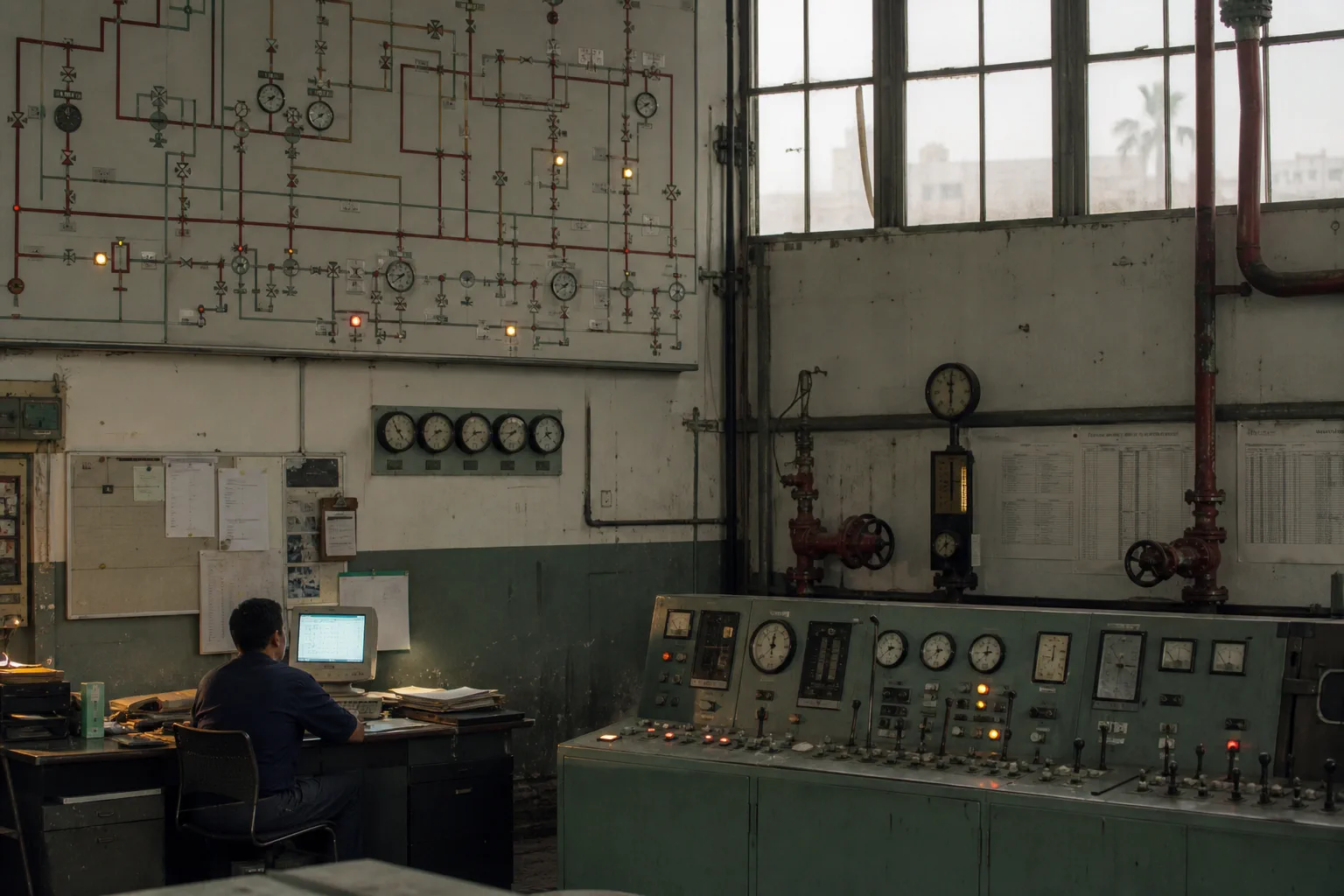
For thirty years, the order in which a mid-sized Portuguese city refilled its water towers was decided by a laminated sheet in a control room, revised by hand roughly twice a decade, and understood completely by four people.
In March 2024 the utility replaced the sheet with a scheduling package. The procurement documents describe the goal as “operational efficiency and auditability.” Nowhere in eighty-one pages does anyone discuss which neighborhoods would experience low morning pressure as a result, because nobody involved thought of the system as making that decision.
It does, though. It decides it every day.
The laminated sheet was not optimal by any measure a procurement officer would recognize. It sent pumps to zones in an order that produced longer runs and slightly higher energy costs. It also encoded, without ever saying so, a set of judgments accumulated across three decades: that the hillside blocks lose pressure first and should be filled first, that the hospital zone is never allowed to drop below a certain reserve, that the eastern district’s older mains need a gentler ramp.
None of that was written down. It was in the order of the list.
Thirty years of judgment was in that sheet. What we handed over was the sheet, not the judgment.
The replacement system optimizes for a cost function assembled during a two-day workshop. It weights energy price, pump wear, and reservoir level. It does not weight household experience at all, because household experience was not a field in the data the utility could supply.
Veyra obtained fourteen months of pressure telemetry through a public records request and compared the year before the transition with the year after. The aggregate numbers look like a success: total pumping energy fell by just over nine percent, and reservoir levels became more consistent overnight.
The distribution tells a different story. In the hillside zone, the number of mornings with pressure below the utility’s own comfort threshold rose from eleven to sixty-three. In the flat central district, it fell to zero.
This is the part that resists a satisfying villain. The utility’s engineers were not indifferent. When shown the distribution, the operations director spent forty minutes at a whiteboard and then said, plainly, that he had assumed the vendor’s model included a fairness constraint because the sales material used the word equitable.
The vendor, asked about this, said the word referred to load balancing across pump assets. Both statements are true. They are simply about different subjects, and the gap between them is where sixty-three mornings went.
There is a version of this article that is about procurement language, and it would be a reasonable article. But the more durable point is about where policy now lives. A city council that wanted to change who gets water first used to amend a document. Now it would need to alter a weighting inside a configuration file that no elected official has ever seen, held by a supplier under a contract that treats the file as commercially confidential.
The utility has since added a minimum-pressure constraint per zone. It took eleven weeks and required a change order. In the old system it would have been a line moved up the sheet.
Senior Writer, Systems
Juno Halvorsen writes about the technical systems that make decisions before anyone notices a decision was available — routing tables, scheduling software, default settings. Halvorsen came to journalism from six years as a network engineer, which shows in the reporting: the questions are specific, and the answers usually arrive as documentation. Files from Lisbon, and from whichever data center will grant access.
Keep reading
Most people never change a default. That makes the default the actual policy — and the person who chose it the actual policymaker.
International time is maintained by a loose federation of laboratories with no enforcement power and shrinking budgets. It works because everyone involved keeps deciding it should.
A harbor authority commissioned a typeface for its signs in 1974 and never replaced it. Fifty-two years later it is the most-read piece of design almost nobody has heard of.
The Dispatch
Not a digest. One piece from the archive or the week ahead, with a note from the editor on why it was worth the reporting time.