Technology— Feature
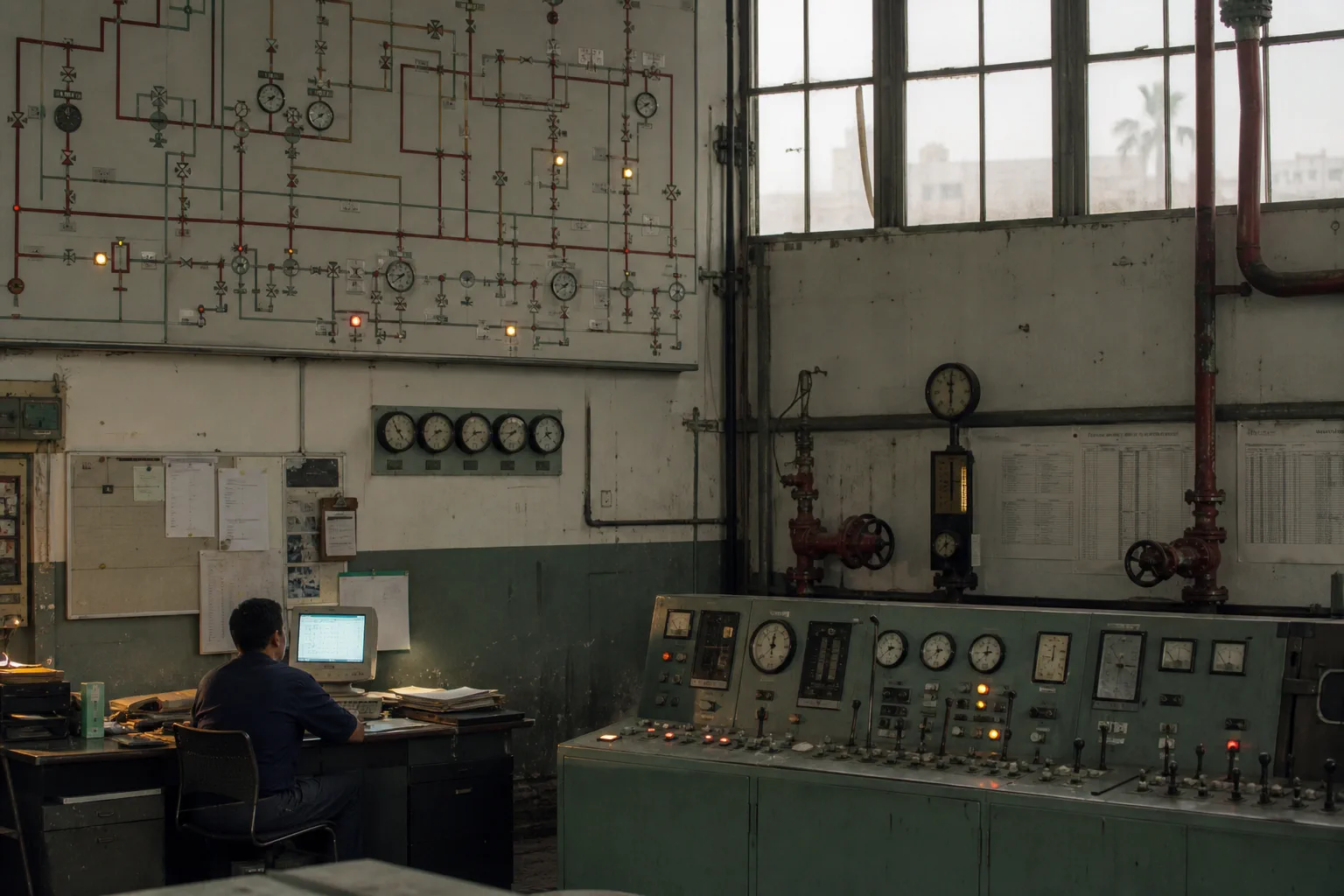
The Scheduler That Decides Who Gets Water
When a mid-sized water utility replaced its paper rota with scheduling software, an unremarkable configuration choice quietly redistributed morning pressure across an entire city.
Technology— Report
The world’s clocks agree because a few dozen underfunded laboratories keep choosing to make them agree. A report on volunteered infrastructure.
Almost everything scheduled, logged, billed, or transmitted depends on a shared answer to a question that has no natural answer: what time is it, exactly, everywhere.
That answer is assembled, not measured. Dozens of laboratories run atomic clocks, report their readings, and a weighted average is computed and published after the fact. No clock is correct. The average is correct by definition, and every participating laboratory then steers itself toward it.
There is no authority that compels participation. There is no penalty for leaving. The arrangement is, in the most literal sense, voluntary — and it has held for over half a century.
Veyra spoke with staff at six national timing laboratories across four continents. All six described the same trajectory: stable or declining real budgets, an aging cohort of specialists, and increasing difficulty explaining the work to funders who assume, reasonably, that time is already solved.
It is very hard to get money for something that has not failed. Our entire success looks like nothing happening.
One laboratory has a single remaining engineer qualified to service its primary standard. Two have deferred instrument replacement past the manufacturer’s recommended interval. None described the situation as a crisis, and all six used some version of the phrase “it is fine for now.”
The honest explanation offered most often was professional pride, which is an uncomfortable thing to find load-bearing in critical infrastructure. The people who do this work believe it matters, know that almost nobody else does, and have arranged their careers around that asymmetry.
The second explanation is structural, and more reassuring. Because the system is an average, it degrades gracefully. A laboratory that drifts is quietly down-weighted. A laboratory that stops reporting simply stops contributing. There is no single point whose failure propagates, which is why the arrangement has survived funding cuts, institutional reorganizations, and at least one national timing service being shut down and restarted six years later.
It is a design that would almost certainly not be approved today. It has no service-level agreement, no single accountable operator, and no revenue. It also has an uptime record that commercial infrastructure rarely approaches.
The engineers we spoke to were consistently more worried about their successors than their equipment. Instruments can be bought. The knowledge of how a particular twenty-year-old standard behaves in July, when the building’s air handling struggles, cannot.
Senior Writer, Systems
Juno Halvorsen writes about the technical systems that make decisions before anyone notices a decision was available — routing tables, scheduling software, default settings. Halvorsen came to journalism from six years as a network engineer, which shows in the reporting: the questions are specific, and the answers usually arrive as documentation. Files from Lisbon, and from whichever data center will grant access.
Senior Writer, Science
Noor Al-Bakri reports on the practice of science — funding, instrumentation, replication, and the long stretches where nothing conclusive happens. Al-Bakri holds a doctorate in atmospheric chemistry and left the laboratory in 2015 having concluded that the more interesting subject was how the laboratory works. Also edits Veyra’s corrections column.
Keep reading
When a mid-sized water utility replaced its paper rota with scheduling software, an unremarkable configuration choice quietly redistributed morning pressure across an entire city.
Most people never change a default. That makes the default the actual policy — and the person who chose it the actual policymaker.
A harbor authority commissioned a typeface for its signs in 1974 and never replaced it. Fifty-two years later it is the most-read piece of design almost nobody has heard of.
The Dispatch
Not a digest. One piece from the archive or the week ahead, with a note from the editor on why it was worth the reporting time.