Society— Feature
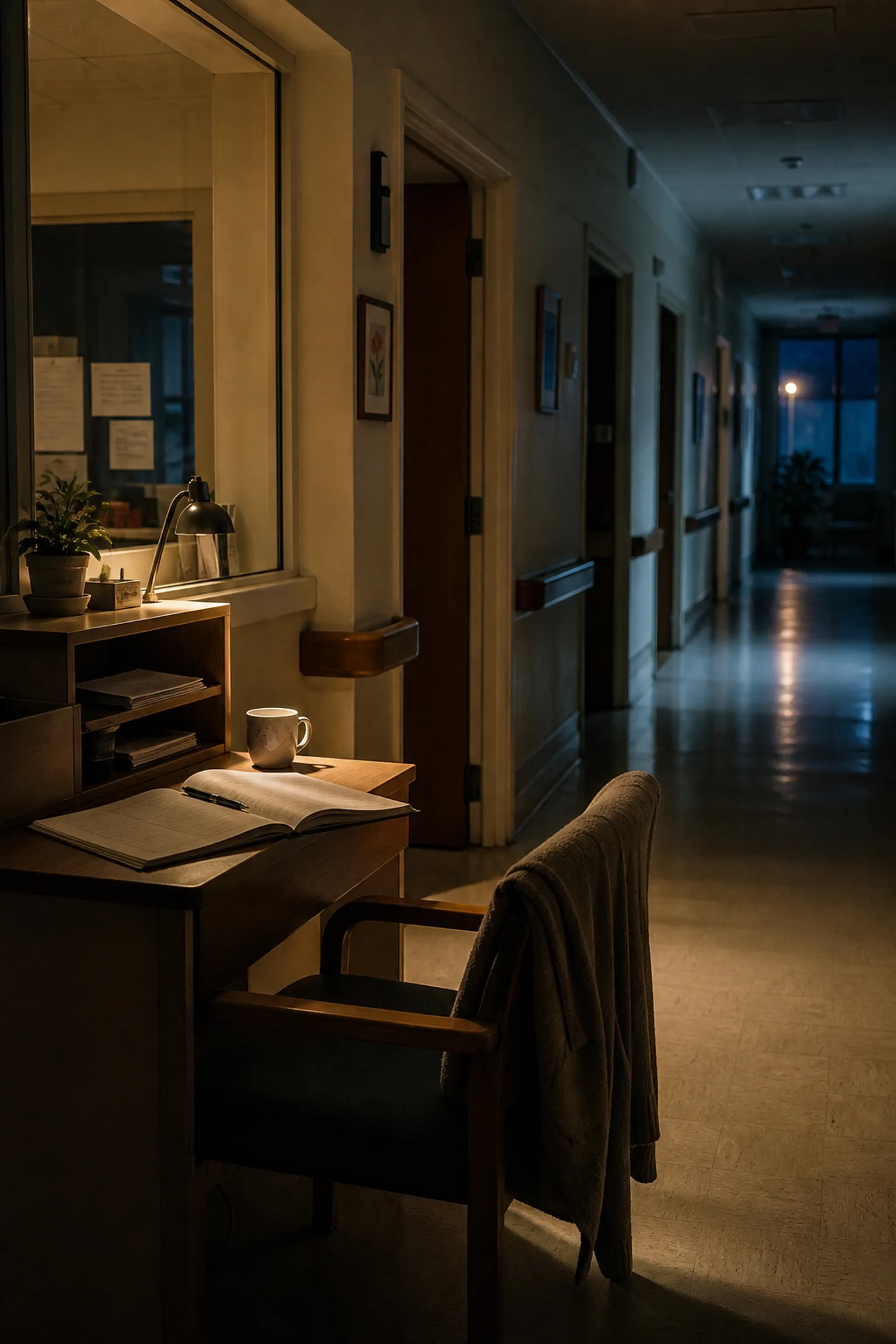
The Night Shift at Meridian Care
Overnight staffing in residential care is decided by a formula almost nobody outside the sector has read. Veyra spent five nights inside one home to see what the formula produces.
Design— Photo Essay
A photo essay from a small-appliance repair shop, where the story of an object is written in the parts that failed.

Porto —
Nuno Faria has repaired small appliances on the same street in Porto for thirty-four years. Over four visits between January and April, we photographed what arrived on his counter, and asked him one question about each: what failed, and could it have not?
The answers form an unusually direct account of how manufacturing decisions land in an ordinary kitchen.
Almost nothing arrives here broken. It arrives here with one small thing broken and no way to reach it.
Faria’s diagnosis, repeated in some form for eleven of the twelve objects, was that the failure was trivial and the access was not. Sealed assemblies, adhesive instead of fasteners, and part numbers that resolve to nothing in any supplier catalog.
He is sixty-one and has no apprentice. When we asked what he would want designers to know, he did not give the answer we expected about repairability standards.
“Put the part that fails first nearest the outside,” he said. “That is all. You already know which one it is. You tested it.”
Staff Photographer
Teodor Brandt shoots most of Veyra’s photo essays and roughly half its features. The working method is slow and repetitive: return to the same location across a season, on film, until the place stops performing. Brandt’s series on Atlantic port labor ran across four issues and remains the magazine’s most requested archive piece.
Design Editor
Santiago Vela edits Veyra’s design section and designed the magazine itself, including the cover plate system used across the archive. Vela trained as an industrial designer and worked for eight years on transit wayfinding before moving to editing, which explains a recurring editorial position: if the public has to be taught how to use something, the something is at fault.
Keep reading
Overnight staffing in residential care is decided by a formula almost nobody outside the sector has read. Veyra spent five nights inside one home to see what the formula produces.
The difference between a wet week and a flooded ward is often six people with hooks and a schedule. A dispatch from the pre-monsoon clearing season.
An interview with a machinist and a glassblower who build scientific instruments to order — and whose names appear in acknowledgments, if at all.
The Dispatch
Not a digest. One piece from the archive or the week ahead, with a note from the editor on why it was worth the reporting time.