Cities— Dispatch
The Drain Crew of Ward Nine
The difference between a wet week and a flooded ward is often six people with hooks and a schedule. A dispatch from the pre-monsoon clearing season.
Society— Feature
Eleven hours, forty-one residents, two staff. A feature about the arithmetic that governs how the very old are looked after.
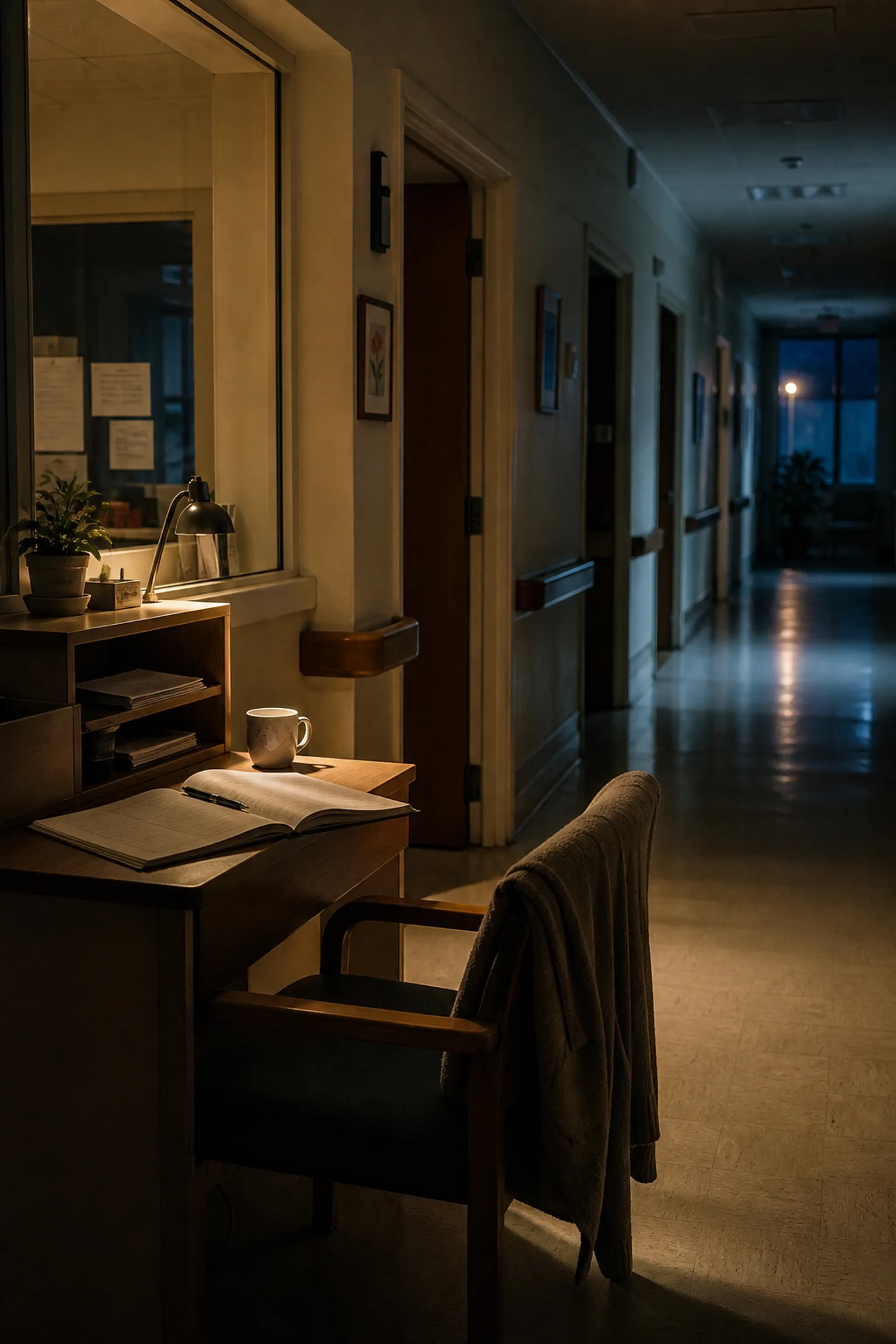
Sheffield —
The night at Meridian Care begins at eight in the evening with a handover that is scheduled for fifteen minutes and has never, in the memory of anyone working there, taken fifteen minutes.
Forty-one residents live in the home. Between eight in the evening and seven in the morning, two people are responsible for all of them. This is not a failure of the home. It is above the minimum the funding formula assumes.
Veyra spent five nights at Meridian in February, with the consent of the operator and of every resident’s family we approached. Names of residents have been changed and identifying details altered.
The work is not what an outsider imagines. There is very little sitting. On the nights we observed, the two staff members walked a checking round every ninety minutes, which takes twenty-eight minutes if nothing happens. Something happens on most rounds.
The last item is the one that most surprised us, and the one every staff member mentioned first. Night staff run the home’s laundry because day staff cannot, and because a resident who has an accident at three in the morning needs bedding at three in the morning.
People think the night is quiet. The night is when the building stops helping you.
Staffing levels in residential care are not set by regulation in the way most people assume. Regulators require that staffing be sufficient, judged against a documented assessment of resident need. The number itself is produced by a dependency tool the operator selects.
Meridian uses a widely licensed tool that scores each resident across mobility, cognition, continence, and clinical need, then converts the total to weekly care hours. Overnight hours are derived as a proportion of the daily figure.
The proportion is the part worth examining. It assumes overnight demand is a fraction of daytime demand, which is true in aggregate and misleading in structure. Daytime work is largely schedulable. Night work is largely not. Two people covering forty-one residents can do the arithmetic — they cannot do it simultaneously in two corridors.
We asked every staff member the same closing question: given one change, what would it be. Nobody said pay first, though everybody raised it.
Seven of nine said a third person on nights. Not for the workload, several clarified, but for the two-person tasks — a resident who has fallen and cannot be lifted safely by one, a resident distressed at four in the morning who needs somebody to stay while the building still needs somebody to walk.
The operator’s finance director, who spoke to us candidly, put the cost of that third person at roughly eleven percent of the home’s total staffing budget, against a margin she described as “low single digits in a good year.”
Both of these things are true at once, which is the whole difficulty. The people doing the work know exactly what is missing. The mechanism that could supply it is not in the room.
At 4:40 on our final night, a resident called Doreen wanted to know whether her sister had arrived. Her sister died in 2009. The care assistant sat on the end of the bed and said she would check, and stayed eleven minutes, and the call system logged two more requests while she did.
Society Editor
Rosalind Mbeki-Turner edits Veyra’s society coverage, with a standing brief to avoid the word crisis unless something is actually breaking. Mbeki-Turner previously ran a small investigative unit covering social care procurement, and still commissions from that instinct: follow the contract, then find the person at the end of it.
Keep reading
The difference between a wet week and a flooded ward is often six people with hooks and a schedule. A dispatch from the pre-monsoon clearing season.

A repair shop’s counter holds a precise record of how things are built now. Twelve objects, photographed as they arrived.
An interview with a machinist and a glassblower who build scientific instruments to order — and whose names appear in acknowledgments, if at all.
The Dispatch
Not a digest. One piece from the archive or the week ahead, with a note from the editor on why it was worth the reporting time.