
Society— Feature
The Night Shift at Meridian Care
Overnight staffing in residential care is decided by a formula almost nobody outside the sector has read. Veyra spent five nights inside one home to see what the formula produces.
Science— Interview
Two people who build the equipment other people’s discoveries depend on, on tolerance, failure, and never appearing on a paper.
In a basement workshop beneath a chemistry building, Teresa Okwuosa runs a lathe and Halvor Rygg runs a torch. Between them they have built, repaired, or rescued equipment for roughly four hundred research projects.
We spoke to them together, over two mornings. The conversation has been condensed and edited for clarity.
Veyra
How does a job usually arrive?
Okwuosa
Badly. Somebody comes down with a drawing from a paper, or a photograph, or a sketch on the back of a printout, and says: can you make this. And the honest first answer is always another question, which is what is it supposed to do. Because the drawing is a description of somebody else’s solution, and usually it is not the solution for this room.
Rygg
With glass it is worse, because people think glass is a shape. Glass is a history. How fast it cooled, how many times it has been reworked. Two identical-looking pieces behave completely differently and only one of them survives being heated on a Thursday.
They bring a drawing. The drawing is somebody else’s answer. We have to find out what the question was.
Veyra
How often does the specification turn out to be wrong?
Okwuosa
Tolerances, constantly. People ask for a hundredth of a millimeter because it sounds serious. That costs four times as much and often makes the thing worse, because a tighter fit means it seizes when it warms up, and their experiment runs warm. So we ask what temperature it lives at. Half the time nobody has thought about it.
Veyra
Do you get credited?
Rygg
In the acknowledgments sometimes. It genuinely does not bother me the way people expect it to. What bothers me is that when the workshop closes — and workshops are closing — nobody notices for about three years, and then a whole department discovers it cannot do a class of experiment anymore and does not know why.
Okwuosa
The knowledge is not in the machines. Anyone can buy the machines. It is knowing that this particular group always underestimates vibration, and that this one asks for stainless when they should be asking for something else.
Veyra
Is anyone learning it?
Rygg
One apprentice between us, funded on a scheme that ends in fourteen months. She is very good. I have no idea what happens in fifteen months and neither does she, and that is the entire state of this trade in one sentence.
Contributing Writer
Kwame Asante-Reid conducts Veyra’s longest interviews, usually across several sittings and rarely with anyone famous. The subjects tend to be builders in the literal sense — instrument makers, bridge engineers, archivists — chosen on the theory that people who work with their hands explain their thinking more precisely than people who work with slides.
Senior Writer, Science
Noor Al-Bakri reports on the practice of science — funding, instrumentation, replication, and the long stretches where nothing conclusive happens. Al-Bakri holds a doctorate in atmospheric chemistry and left the laboratory in 2015 having concluded that the more interesting subject was how the laboratory works. Also edits Veyra’s corrections column.
Keep reading
Overnight staffing in residential care is decided by a formula almost nobody outside the sector has read. Veyra spent five nights inside one home to see what the formula produces.
The difference between a wet week and a flooded ward is often six people with hooks and a schedule. A dispatch from the pre-monsoon clearing season.
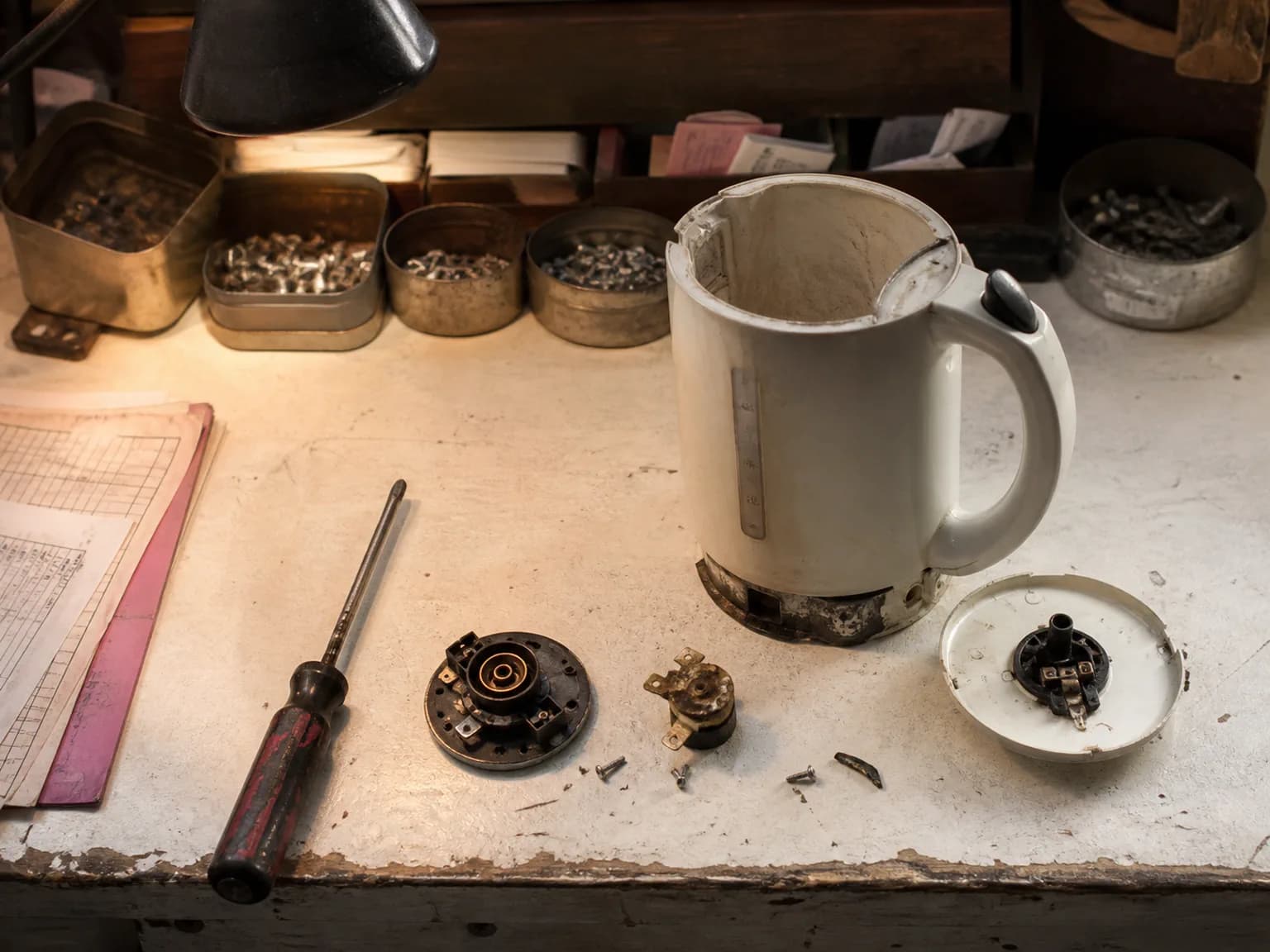
A repair shop’s counter holds a precise record of how things are built now. Twelve objects, photographed as they arrived.
The Dispatch
Not a digest. One piece from the archive or the week ahead, with a note from the editor on why it was worth the reporting time.