Science— Interview
The Instrument Makers
An interview with a machinist and a glassblower who build scientific instruments to order — and whose names appear in acknowledgments, if at all.
Science— Feature
A long-running seabed monitoring project spent most of a decade producing null results. What that decade cost, and why it mattered.
Tromsø —
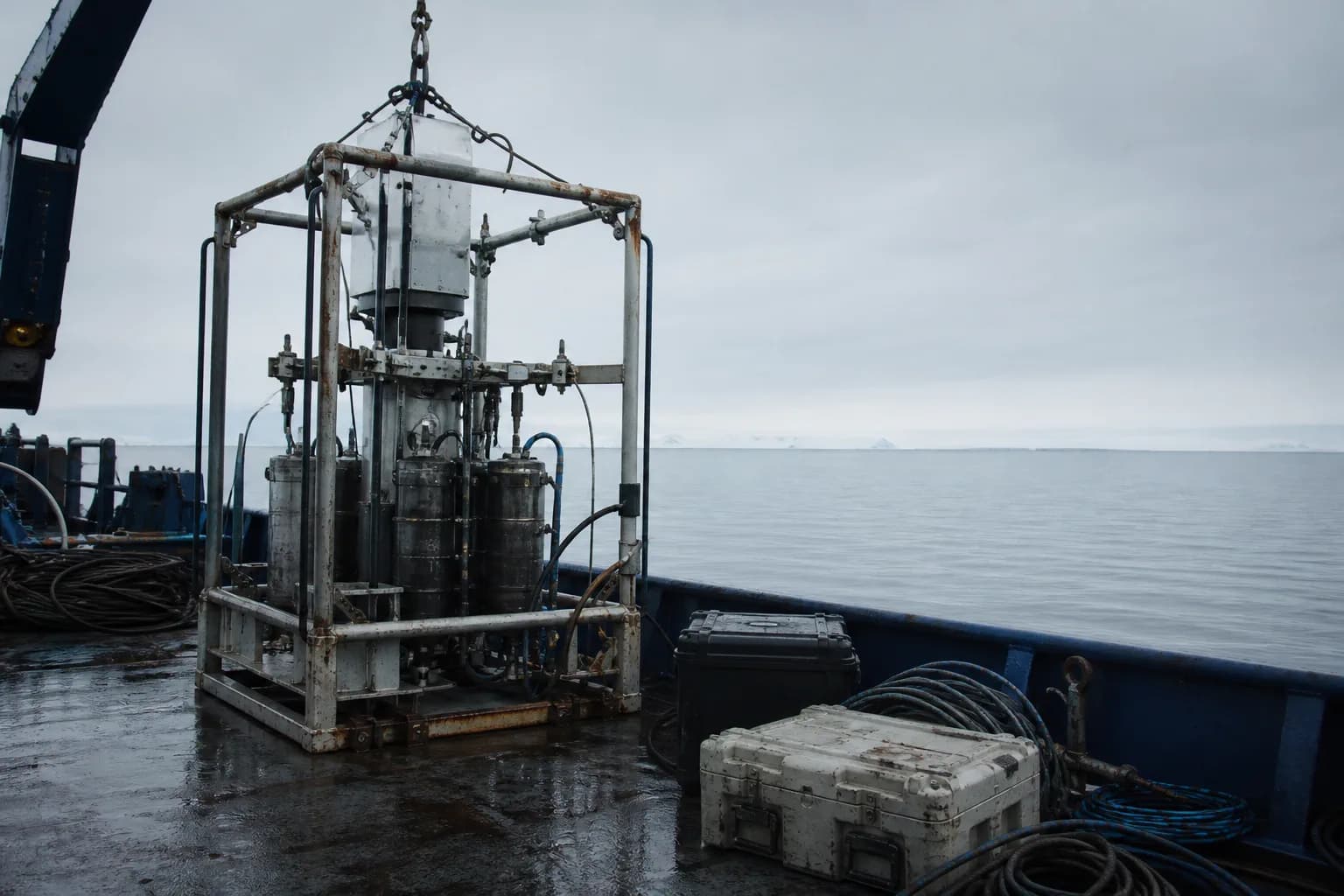
The instruments went down in 2015. They were recovered, serviced, and redeployed every eighteen months, at considerable expense, in weather that permits the operation about four months a year.
For nine years the array recorded, in the words of its principal investigator, “exactly what we expected, which is the worst possible outcome for a grant renewal.”
In the autumn of 2024, it recorded something else. The finding has since been replicated by two other groups and has changed a modeling assumption used across the field. It could not have been detected in under a decade of continuous observation, and the project came within one funding cycle of not existing that long.
Nothing about this is unusual, which is the point. Long-baseline observation is the only way to detect changes that occur slowly, and it is systematically disadvantaged by every mechanism used to allocate research funding.
Every renewal, we had to explain that finding nothing was the finding. It never once got easier.
Not gracefully. Veyra reviewed the project’s funding history across eleven years. It was sustained by four separate grants from three bodies, two periods of institutional bridging finance, and one year in which the ship time was donated by another project that had spare capacity on a transit leg.
The 2021 gap is the one everyone remembers. Funding lapsed in March and did not resume until the following January. The instruments stayed on the seabed, unserviced, past their design interval. Four of the eleven nodes were lost. The data from that period carries a caveat in every publication that uses it.
Had the recovery vessel not been available in early 2022, the entire nine-year baseline would have been broken, and the 2024 signal would have been uninterpretable — a change measured against nothing.
Several funders have introduced longer instruments — ten- and fifteen-year awards specifically for observational infrastructure. They remain a small fraction of total allocation, and researchers we spoke to described a second-order problem: a fifteen-year award concentrates risk, because losing one is catastrophic rather than inconvenient.
The alternative proposal, favored by most of the people who actually maintain arrays, is duller and probably better. Fund the maintenance separately from the science. Treat a monitoring array the way a country treats a tide gauge: as infrastructure that exists, with a budget line that does not have to justify itself with a discovery every three years.
“We built something that can see slowly,” the investigator said. “Then we asked it to prove itself quickly. That is not the instrument’s fault.”
Senior Writer, Science
Noor Al-Bakri reports on the practice of science — funding, instrumentation, replication, and the long stretches where nothing conclusive happens. Al-Bakri holds a doctorate in atmospheric chemistry and left the laboratory in 2015 having concluded that the more interesting subject was how the laboratory works. Also edits Veyra’s corrections column.
Keep reading
An interview with a machinist and a glassblower who build scientific instruments to order — and whose names appear in acknowledgments, if at all.
Publication is the beginning of a claim’s life, not the end of it. What actually determines whether a finding lasts.
An interview with a drum maker whose instruments are built to last a century — and who turns away most of the people who want to buy one.
The Dispatch
Not a digest. One piece from the archive or the week ahead, with a note from the editor on why it was worth the reporting time.