Culture— Essay
What the Wedding Band Knows
Eighty weddings a year, four hours each, and no two crowds alike. What a working covers band understands about an audience that no recommendation system has managed to learn.
Culture— Interview
An instrument maker in Accra on grain, patience, humidity, and why he refuses to sell to people who have not played one first.
Accra —
Kwesi Anoff’s workshop is in a yard behind a printing business in Osu, under a roof of corrugated sheet that makes conversation impossible during rain. He has been making drums there for twenty-six years. He is fifty-four, unhurried, and mildly amused by the fact that a magazine wants to talk to him.
We spoke over three afternoons in April. The conversation below has been condensed and edited for clarity.
Veyra
You turn down customers. How many?
Anoff
Most of them. Not because I am proud. Because a drum I build takes eleven weeks and it is not finished when it leaves. It finishes over about two years, with the person playing it. If nobody plays it, it does not finish. It just becomes furniture that I made.
Veyra
How do you know who will play it?
Anoff
I ask them to play one here. Not well — I do not care about well. I want to see whether they listen to it while they are hitting it. Some people hit and look at me. Those people I do not sell to.
Veyra
Let’s talk about the wood. You wait years.
Anoff
Three years minimum, sealed at the ends so it dries from the middle outward and not in a rush. Wood in a rush cracks. Everybody knows this and almost nobody can afford to know it, because waiting three years means you have three years of money sitting in a stack against a wall doing nothing. That is the whole difficulty of this work. Not skill. Storage.
The hard part of this trade is not carving. It is being able to afford to wait.
Veyra
Your instruments go abroad. Does the climate change them?
Anoff
Enormously, and everybody is surprised, which surprises me. A drum built in this humidity and shipped to a dry apartment in a cold country will move. The head goes tight, the shell shrinks a little differently than the head does. I tell people: for the first winter, do not fight it. Loosen it, let it sit, come back. They want to fix it immediately. Instruments do not like being fixed immediately.
Veyra
Who is learning this from you?
Anoff
Two people. One is my sister’s son, who is good and does not love it. One is a woman from Kumasi who is not yet good and loves it very much. I am betting on the second, which everybody tells me is the wrong bet. I have made this bet before and been right twice and wrong once.
Veyra
What happens to the drums after you?
Anoff
They keep going. That is the point of them. There is a drum in a church in Cape Coast that my teacher’s teacher built, and it is still in weekly use, and it has been re-headed maybe nine times. The shell is the instrument. The head is a consumable. If you build the shell properly, you are building something that will be repaired by people you will never meet. I find that a very good reason to be careful.
Contributing Writer
Kwame Asante-Reid conducts Veyra’s longest interviews, usually across several sittings and rarely with anyone famous. The subjects tend to be builders in the literal sense — instrument makers, bridge engineers, archivists — chosen on the theory that people who work with their hands explain their thinking more precisely than people who work with slides.
Keep reading
Eighty weddings a year, four hours each, and no two crowds alike. What a working covers band understands about an audience that no recommendation system has managed to learn.
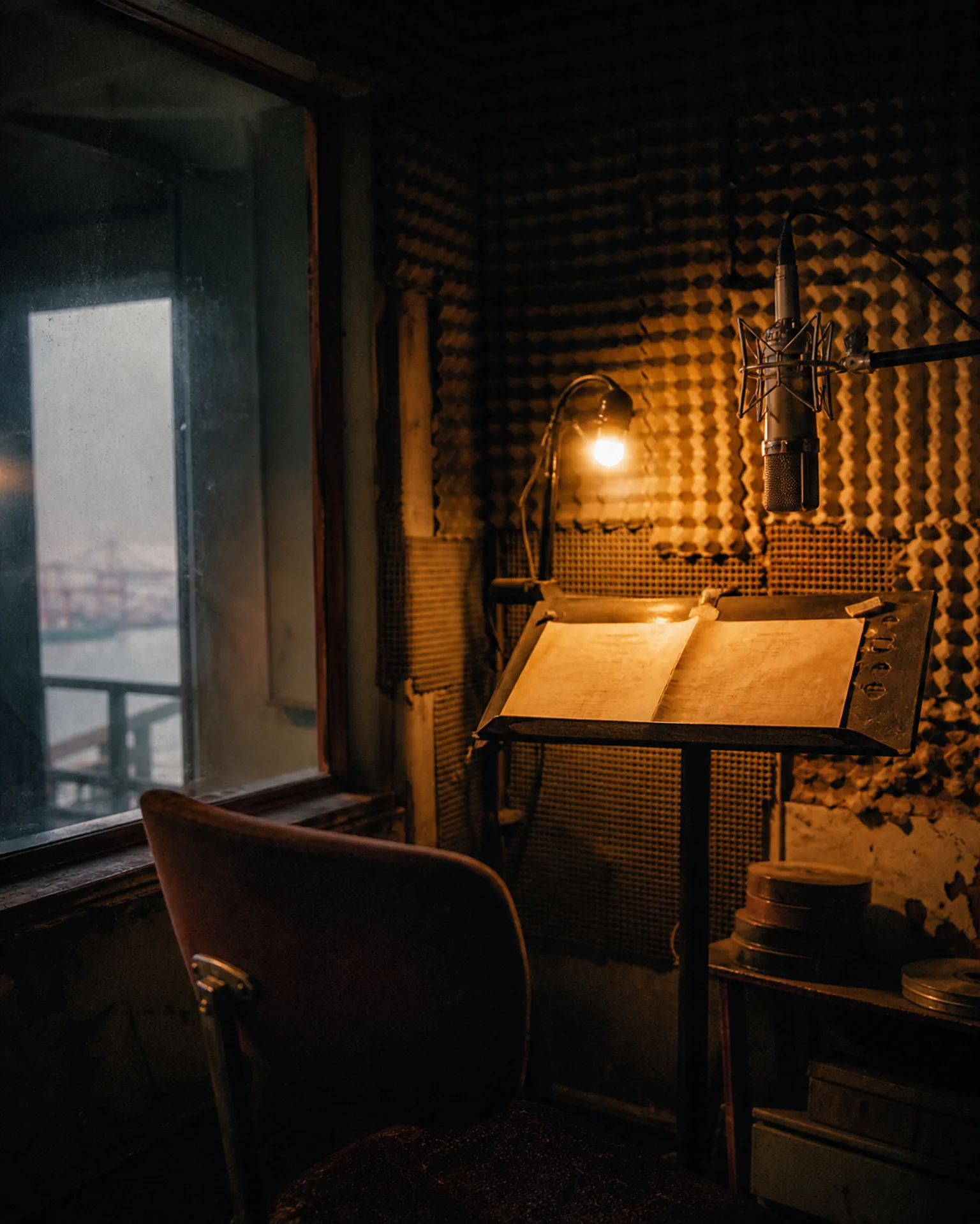
A two-room studio above a hardware shop in Lisbon dubbed four decades of children’s television into Portuguese. What happens to a language when the work of translating it stops being a career?
An interview with a machinist and a glassblower who build scientific instruments to order — and whose names appear in acknowledgments, if at all.
The Dispatch
Not a digest. One piece from the archive or the week ahead, with a note from the editor on why it was worth the reporting time.